15 Motivation Sparks for University Students (Quick Checklist)
Why motivation drops in university settings (and what instructors can influence)
University motivation often fades for reasons that have less to do with “work ethic” and more to do with friction in the learning environment. Common culprits include unclear expectations, low perceived relevance (“Why are we doing this?”), fear of failure, and long feedback loops where students don’t learn whether they’re on track until a midterm or final.
Three levers are especially responsive to small instructor moves: autonomy (choice and voice), competence (scaffolded challenge), and relatedness (belonging and trust). These align closely with self-determination theory, summarized by the APA Dictionary of Psychology. When students feel a little more in control, a little more capable, and a little more connected, engagement rises without lowering the bar.
Motivation also stabilizes when progress is visible weekly. A two-minute reframing at the start of class, a clearer rubric, or a quick “what good looks like” example can prevent a disengagement spiral that’s hard to reverse later.
How to use a checklist system without adding prep time
A checklist system works best when it stays lightweight. Choose three tactics to run consistently for two weeks, then review basic signals: attendance, participation patterns, and assignment submission quality. If something helps, keep it; if not, swap it.
To avoid extra prep, attach each tactic to a single touchpoint you already have: the opening minutes of class, the assignment brief, one discussion prompt, or a feedback comment bank. That way the checklist doesn’t become “one more thing”—it becomes a repeatable routine.
Use simple if–then triggers. If participation drops, then switch to structured turn-taking. If late work spikes, then add a milestone checkpoint. Track impact with low-effort signals such as one-minute reflections, exit tickets, or a quick poll.
The 15 motivation sparks (grouped into fast wins and deeper builders)
Fast wins (today/this week)
- Clarify the “why” of an activity in one sentence tied to a skill students will reuse.
- Run a low-stakes warm-up that lets everyone start with a small success.
- Add visible success criteria (what “meets expectations” looks like).
- Offer a small choice (topic options, example selection, or format constraints).
- Normalize productive struggle by showing a worked example and a “common mistake” example.
Momentum builders (this unit)
- Create milestone deadlines so students see progress before the final submission.
- Use brief, frequent feedback (even two targeted sentences can redirect effort).
- Incorporate peer explanation so students articulate reasoning, not just answers.
- Add real-world application through cases, artifacts, or professional scenarios.
- Include retrieval practice (short recall prompts that strengthen memory and confidence).
Belonging and trust (ongoing)
- Learn and use student names where possible (or use name tents / roster photos).
- Set respectful discussion norms and practice them with a short structured activity.
- Invite student-generated examples so the course reflects diverse perspectives.
- Ensure inclusive participation structures (spoken, written, small-group, anonymous).
- Communicate high standards with support: “This is challenging, and you can do it with the right steps.”
Aim for balance: challenge plus support makes rigor feel achievable instead of punishing. Guidance on practical feedback and assessment design can be found through institutions like UCL’s assessment and feedback resources, and evidence-informed teaching studies can be explored via ERIC.
Quick classroom moves mapped to typical teaching situations
Different formats need different “spark” choices. In large lectures, micro-polls paired with a clear prompt and a timed pair-share can lift attention fast. In seminars, rotating roles (summarizer, connector, skeptic) distributes airtime and reduces dominance effects. In labs or tutorials, converting directions into checkpoints reduces anxiety because students can confirm they’re on track.
Motivation sparks by scenario (pick one per class session)
| Scenario | Student need | Checklist action | Time cost |
|---|---|---|---|
| Low participation | Psychological safety + structure | Think–pair–share with sentence starters and timed turns | 3–6 minutes |
| Confusion about assignments | Clarity + competence | Post a 4-point success checklist (purpose, steps, criteria, examples) | 5–10 minutes |
| Procrastination | Progress visibility | Add a milestone submission (outline, draft, or plan) with minimal points | 10 minutes setup |
| High anxiety before exams | Control + strategy | Run an exam wrapper: plan, practice items, and reflection questions | 5 minutes |
| Surface-level learning | Challenge + retrieval | Start class with 2–3 recall questions and a brief debrief | 3–5 minutes |
Turning motivation into measurable learning gains
Digital download workflow for busy instructors
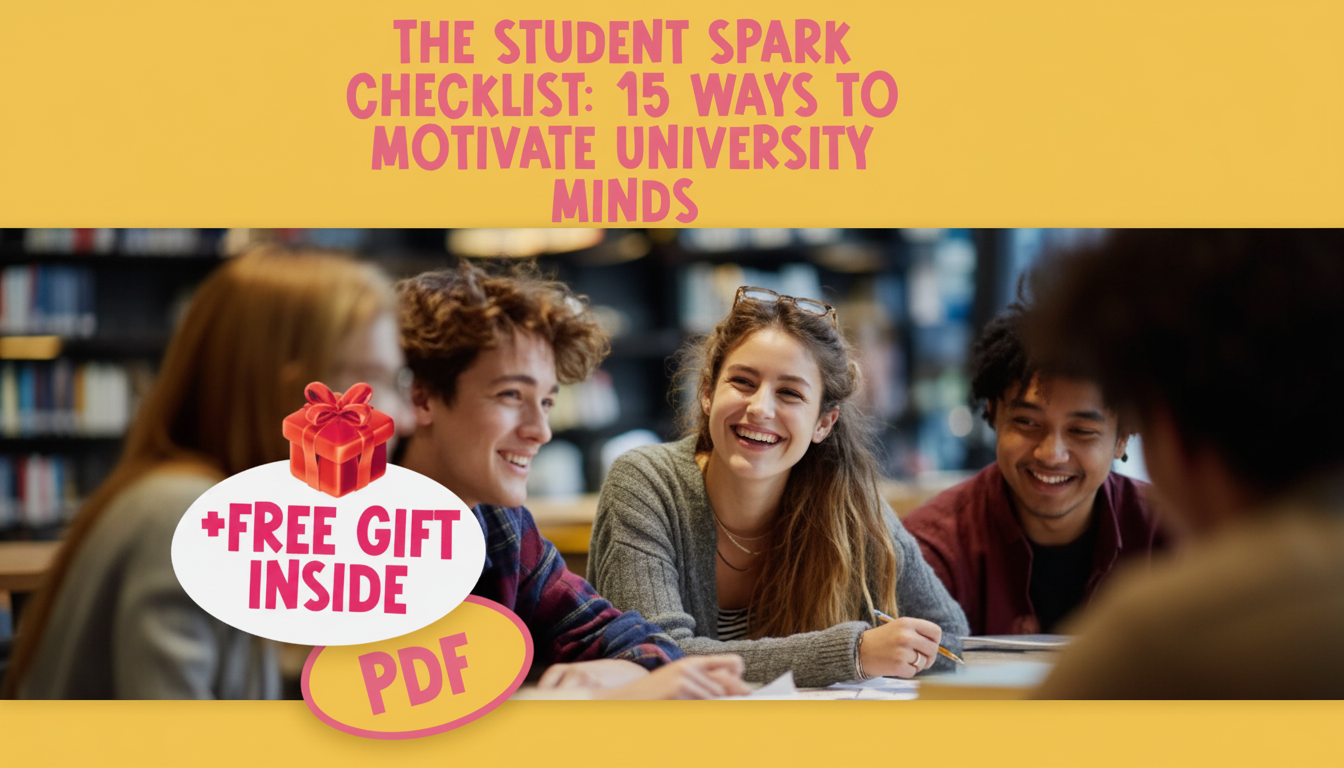
For a ready-to-use printable, The Student Spark Checklist: 15 Ways to Motivate University Minds (PDF download) can be saved to a phone/tablet for quick reference or printed as a one-page guide for a clipboard.
If you like checklist-based planning across different parts of life (and want a separate, non-teaching example of how detailed checklists reduce friction), Car Safety Inspections eBook: Ultimate Guide for DIY Checklists, Tools, and Tips is another digital checklist resource that emphasizes step-by-step clarity and quick verification.
When the checklist helps most (and how to adapt it)
FAQ
What are the most effective ways to motivate university students quickly?
Use quick clarity and momentum tactics: state the purpose of the task, show visible success criteria, offer a small choice, add a low-stakes warm-up, and give brief fast feedback. These work best at the start of class or at the moment an assignment is introduced.
How can professors motivate unmotivated students without lowering standards?
Keep expectations high while adding scaffolds that make progress doable: milestone checkpoints, models of strong work, and process-focused feedback with one next step. Autonomy-supportive choices (within clear requirements) also increase buy-in without reducing rigor.
Does a motivation checklist work for online university courses?
Yes—online checklists often work even better when they emphasize structure: short targeted prompts, model responses, clear rubrics, and milestone deadlines. Structured peer interaction (small groups, assigned roles, or guided replies) helps maintain relatedness and accountability.











Leave a comment